This is a small lineside hut on the outskirts of King’s Lynn, very close to the bridge that took the former Midland & Great Northern tracks over the current Fen Line. At the right time of year, such as the April in which I took the photo, it is rather beautifully surrounded by reeds.
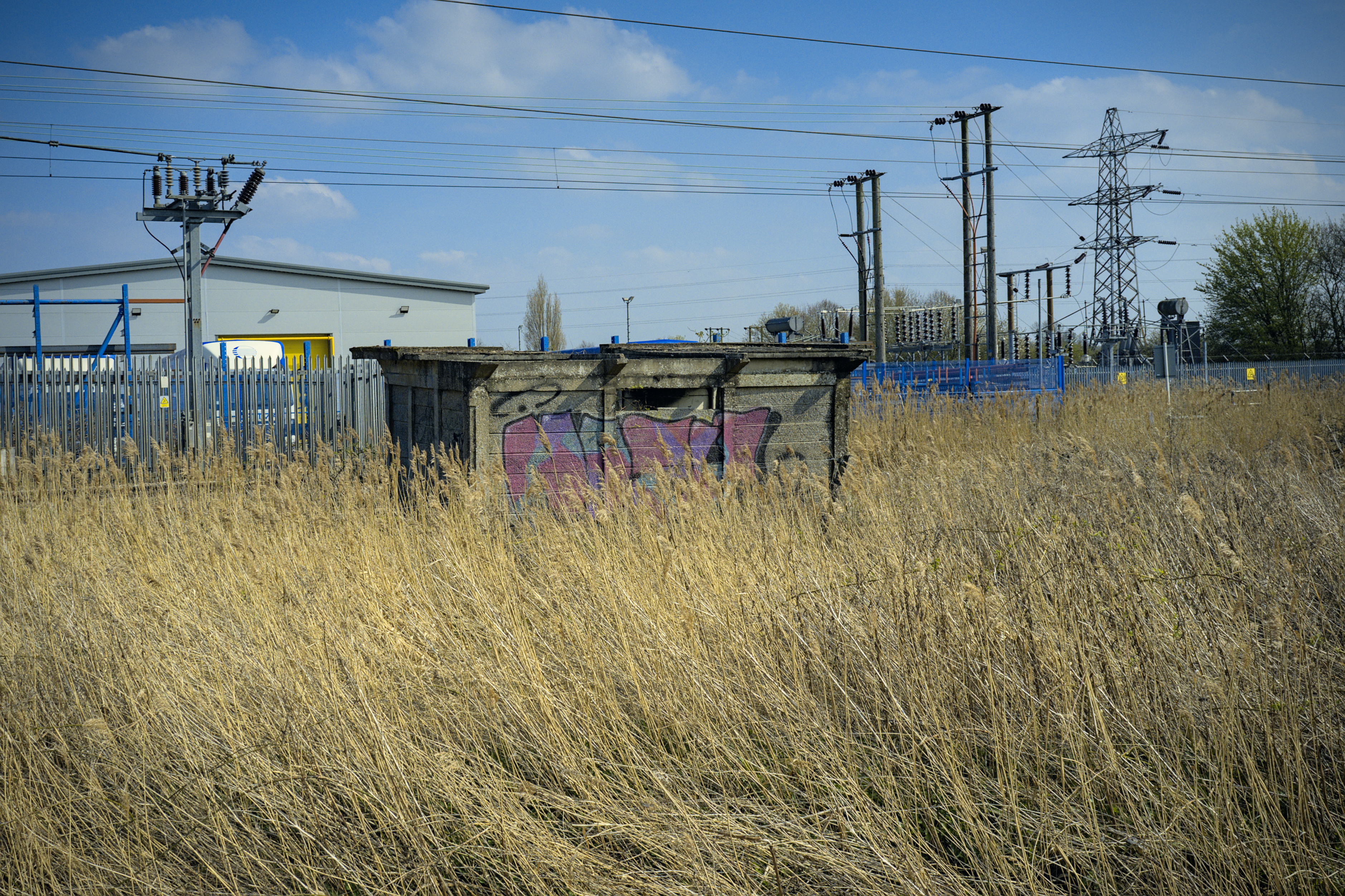
There are plenty of these at the side of many railway lines, of very similar construction; there’s at least one more exactly like this within the boundaries of King’s Lynn, and several more scattered down the Fen Line. And like probably every other train commuter, I occasionally harbour fantasies of offering some sort of rude gesture to society at large, throwing away the computer (or perhaps acquiring a small solar panel), and making one of these my very small home. Wouldn’t that be nice? (And impractical. Also illegal! Besides, society is actually pretty OK; I like people.)
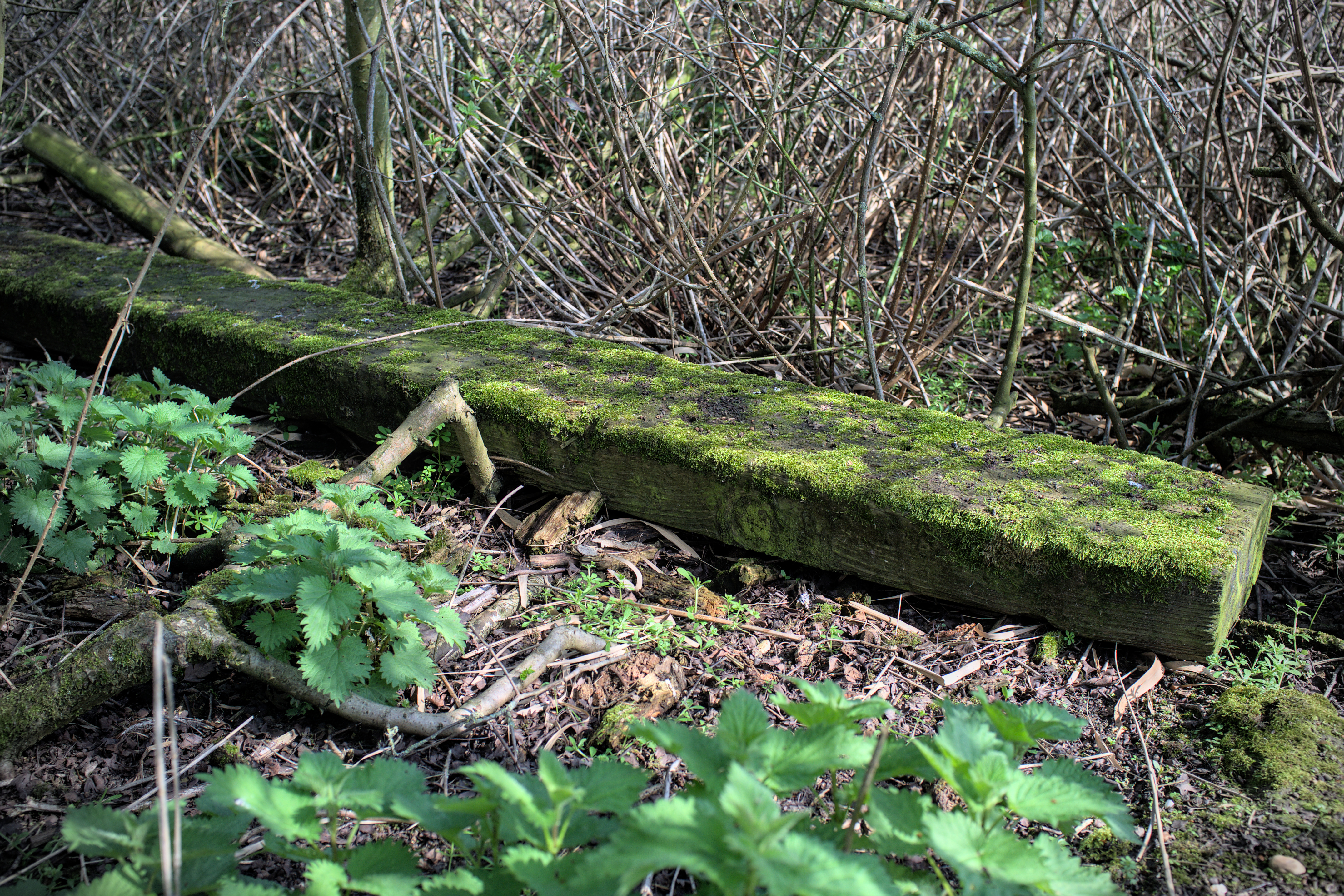
In the immediate vicinity of this hut, there are some railway sleepers in some vegetation, which have not yet entirely rotted away.
This hut isn’t unique, but it is quite pleasing; it is compact, and of sturdy twentieth-century concrete plank construction. Many, maybe most, surviving lineside huts you will see look like this; it is not because this was the only design of lineside hut, but because these were the ones sturdy enough to survive.
I like this hut, and not just because it gives me an opportunity for an historical digression.
In the past, routine maintenance of the permanent way - the tracks themselves - was performed by a large army of small teams of men. Each of those small teams would be responsible for maintaining a stretch of track about two to three miles long - a mile to a mile and a half each side of one of these huts. These huts offered a space warmed with simple stoves as shelter from the weather, a place to make tea, and a place to store equipment.
What became of the lineside hut, then?
Railways in the past had different needs. Previously, tracks would have needed ongoing maintenance. Of course they do now too; with continuous welded rail rather than fishplates they require much less. And that maintenance is much more likely to be mechanised; giant rail-based machines replace muscle, and track can be inspected these days with dedicated trains travelling at up to 125 miles per hour. Inspection and maintenance today does not require armies of people on the ground.
For those jobs that must be done by manual labour from teams of people, the way such teams has, like much else about the railways, been drastically altered by road transport. Instead of fixed teams with responsibility for maintaining a stretch of track, mobile teams in road vehicles go from place to place to inspect things and fix problems. The larger of these vehicles serve the same functions as the fixed huts: a place to rest, shelter, and drink tea. Like much else that has happened in the century or so since this hut was constructed, this has some obvious efficiencies; also like much of the other things, for better or worse, it means that labour is less permanent and more fungible.
So this hut looks like an empty concrete box in the middle of nowhere, because it is. Of course, it is also a symbol of how railways needed much more manual labour in the past. But it’s also a symbol of wider social changes; the legions working in the coal mine gave way to the gas pipe, the carpenter gave way to the factory, the “job for life” gave way to “the job”, and the lineside hut gave way to the truck and the machine and the computer. So a little shed is as much a part of our railway history as any train or station is. I am glad it was built sturdily enough to survive to this day.
You can see this hut from non-railway land at the edge of a field nearby, which is how I visited it. I didn’t attempt to enter it to take photographs inside; doing this would require trespassing on railway land. It is best that you do not do this either.
Sources
- Platelayers Huts on the RailUK forums.
- Settle Carlisle Railway Conservation Area (SCRCA)